
Quick answer
USDC payments make sense when a business wants dollar-denominated money to arrive fast, stay easy to reconcile, and move without waiting on bank windows. The catch is operational: you still need rules for invoice matching, refunds, conversion timing, and wallet support. This guide shows where USDC fits in invoices, checkout, cross-border receipts, and treasury, and where it creates more work than it removes. If you need the next decision after this, compare it with USDC vs USDT for Business Payments: Which to Accept? and the broader Stablecoin Payments for Business guide.
For neutral context, this guide cross-checks the topic against Cryptocurrency. So the recommendation is grounded in external market signals rather than only product claims.
USDC payments are not valuable because they sound modern. They are valuable when money has to move in a way finance can still explain a week later. That is a narrow test, and it is the right one. A merchant can receive USDC through an invoice, at checkout, from a foreign customer, or as part of a treasury process, but each route creates a different job for finance, support, and operations.
Circle’s own USDC pages frame the asset as a dollar-backed digital payment instrument, while Stripe’s stablecoin docs show how acceptance works in a checkout flow. Those references are useful because they establish the rail. They do not, however, tell a business whether the rail belongs in invoicing, whether refunds will frustrate customers, or whether the finance team can close the books without manual cleanup. That is the gap this page fills, and it is why the question is not “can we accept USDC?” but “what business problem are we solving with it?”
The answer changes by workflow. In B2B collections, USDC may reduce days of waiting and the back-and-forth that comes with wires. In checkout, the same token can create friction if the customer does not already hold a wallet. In treasury, it can act as a short-lived dollar balance, but only if the business knows who owns it and when it gets swept out. If those rules are unclear, the payment rail becomes another thing the team has to interpret.
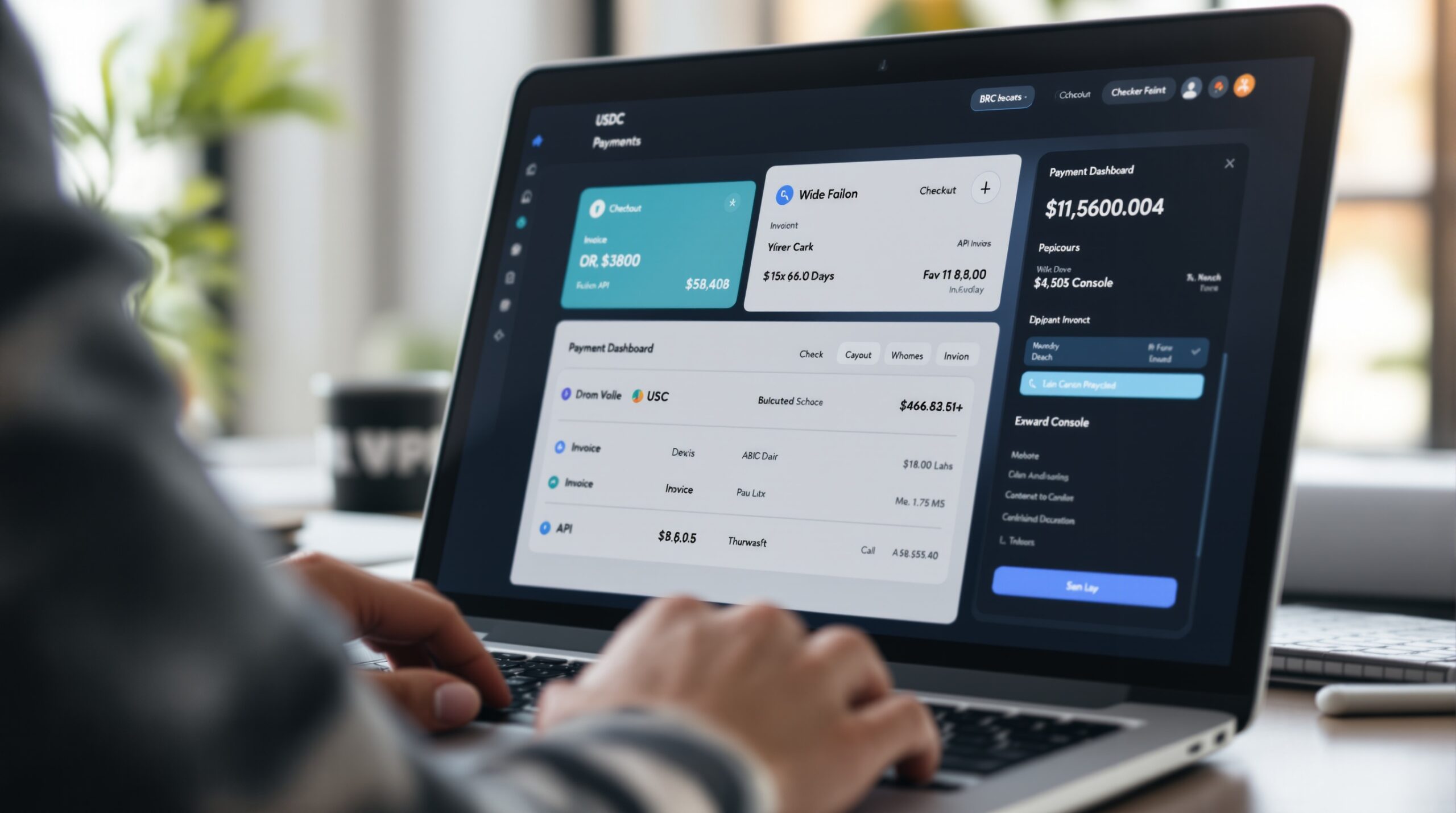
Why USDC fails when the workflow is wrong
Most USDC problems are not payment problems. They are handoff problems. The money lands, but nobody owns the next step with enough precision. Sales thinks the deal is paid. Finance still needs the invoice ID. Support hears about the issue three days later, usually when a customer wants proof that a refund or reversal is already in progress.
That is where the hidden cost shows up. A team that accepts USDC without defining the post-receipt flow often ends up doing double work: first to receive the payment, then to rebuild the story around it. In smaller teams that means a few extra hours each week. In larger teams, it becomes a recurring close-time mess that keeps repeating because no one wrote the rule down.
Leaders in the space do a good job of explaining what USDC is. Circle explains redemption and reserve structure, Stripe explains payment acceptance, and platform pages explain access. But business teams do not lose money on the definition. They lose time when no one decides whether the receipt should be held, converted, or reconciled immediately. That is why a merchant workflow lens matters more than a token explainer.
If the payment method cannot tell the business who owns the next step, it is not a clean fit. A finance lead needs to know whether the asset is entering treasury, closing an invoice, or simply passing through. Otherwise the company gets a payment event but not a finished process.

Where USDC payments fit in a business flow
USDC means different things depending on where it appears. For an AR team, it is a customer receipt. For a checkout team, it is a payment option. For treasury, it is a dollar-denominated asset that can be held for hours or days. The operational shape changes with the use case, so the implementation should change too.
Invoice collection
Invoice collection is usually the cleanest fit. The buyer already knows the amount, the seller already knows the counterparty, and the payment is there to finish a transaction rather than start one. In this setup, USDC can cut waiting time and remove some of the wire friction that slows down cross-border billing.
The catch is matching. If the invoice ID, customer ID, and transaction hash are not tied together, finance ends up reassembling the record by hand. That is manageable at ten invoices a month. It becomes a real problem at volume. A clean AR process should define what gets logged, who checks it, and when the invoice is marked closed.
Checkout payments
Checkout is harder because the customer has to do more work than with a card. They need a wallet, the right network, and enough confidence to complete the transfer. Stripe’s stablecoin docs make the flow look simple, but the buyer still has to leave the familiar checkout path and finish a crypto-native action. That adds friction at the exact point where conversion is most fragile.
For a digital product with a high-intent buyer, that friction can be acceptable. For retail, low-intent traffic, or a buyer who does not already use wallets, it usually is not. The useful question is not whether checkout can support USDC. It is whether your customer base will complete it without a support ticket.
Cross-border receivables
Cross-border receivables are often where USDC earns the clearest case. A business that sells services or software across markets may prefer a dollar-denominated receipt that does not wait on correspondent banking. That can matter when payment delays block delivery, especially for agencies, SaaS vendors, contractors, and export-heavy teams.
The benefit is not just speed. It is predictability. If the company can receive in USDC, convert on a known schedule, and book the receipt cleanly, finance stops chasing value through multiple bank hops. If the conversion step is undefined, the gain disappears into treasury confusion and the team ends up treating a simple receipt like a special case.
Treasury and settlement use
Treasury use is narrower, but it is still operationally useful. Some businesses hold USDC briefly because they want a dollar-denominated balance that moves faster than a bank transfer and is easier to segment than a pile of ad hoc payouts. That can help with timing, especially if funds need to be swept after a close, a payout cycle, or an internal approval step.
The risk is shadow ownership. If one person knows the wallet, another person knows the invoice, and a third person knows the conversion rule, the balance becomes hard to manage. For a small team that may be tolerable. For a growing finance function, it is a recipe for avoidable reconciliation work.
| Workflow | Who owns it | What arrives | What must happen next | Break point |
|---|---|---|---|---|
| Invoice collection | AR / finance | USDC payment to wallet | Match invoice, close receivable, decide conversion | Payment not tied to invoice ID |
| Checkout | Revenue ops / payments | Customer wallet payment | Confirm success, show receipt, handle refund path | Wallet or network mismatch |
| Cross-border receivable | Finance / treasury | USDC from foreign buyer | Set conversion timing and FX policy | No conversion rule |
| Treasury hold | Treasury / controller | USDC balance | Revalue, segment, or sweep to fiat | Shared wallet with no owner |
What buyer behavior tells you
Buyer behavior is the strongest filter of all. If customers already use wallets, USDC can feel natural. If they ask for a PDF invoice and pay by card, the same flow becomes friction. Good payment design follows the customer’s habits instead of forcing a new one into the checkout path.
That distinction is why USDC can work well for enterprise procurement and fail in consumer retail. The payment rail is not changing the buyer’s job. It is changing how much work the buyer has to do to finish that job.

What happens after a USDC payment lands
The cleanest way to manage USDC is to treat it as a four-step flow: receive, hold, convert, reconcile. The payment is only the first step. The business value appears only when the next three are defined with the same care as the first.
Receive
Receiving means the on-chain transaction is visible and the amount is confirmed. That part is mechanical. The real question is whether the business has a place to put that information. If the payment lands in a wallet but not in the operating system, the transaction is complete on-chain and unfinished internally.
Hold
Holding is a policy choice. A company may keep USDC for a few hours while it waits for a payout batch, or for a few days while treasury decides on conversion. The longer it holds, the more it needs rules for access, custody, and reporting. A balance that is easy to move is still a balance that needs ownership.
Convert
Conversion is where treasury discipline becomes visible. Some businesses convert immediately to USD to keep close simple. Others batch conversions daily or weekly to reduce admin work. The right answer depends on the reporting cadence and risk tolerance, but the decision should be written before the first payment lands, not made ad hoc by whoever is online.
Reconcile
Reconciliation is the step that gets underestimated most often. The team needs the invoice or order ID, the customer ID, the transaction hash, and the conversion timestamp. Without those fields, finance ends up searching wallet explorers, spreadsheets, and chat threads to reconstruct the record. That is not a process. That is cleanup.
Circle’s mint and redeem model matters here because it explains why USDC behaves like a dollar asset rather than a volatile token. But the merchant still has to define its own operating rule. Stripe’s docs show that stablecoin payments can settle into a USD balance in some setups, yet the internal books still need a handoff from payment event to accounting entry. The rail changes how money arrives, not whether the company needs a workflow.
At about 50 to 100 payments a week, the missing handoff rule starts to bite. Refunds get delayed because nobody knows which wallet should receive the reversal. Memo fields go missing. Close time stretches. A team that defines the handoff early usually saves more time than a team that keeps improvising and calling it flexibility.
Operational checks before you accept USDC payments
Before a business accepts USDC at scale, it should answer four practical questions: how refunds work, what dispute path exists, which networks and wallets are supported, and what limits or coverage rules apply. Those are not edge cases. They are the places where a rollout usually breaks.
Refund handling
Refunds are where stablecoin acceptance becomes real. Stripe documents that refunds return to the original wallet as stablecoins. That is efficient if the customer still controls the wallet and expects a wallet-based return. It is awkward if the buyer expects a card-style reversal in fiat or if the business has already converted the funds.
The operational rule needs to say who approves a refund, which wallet receives it, and whether the refund is immediate or batched. Without that rule, support asks finance to “just reverse it,” and finance ends up rebuilding the payment path by hand. The first refund reveals whether the team actually has a policy or only a payment button.
Chargeback profile
USDC changes the dispute profile instead of copying the card model. The business may face fewer classic chargebacks, but it also loses the familiar safety net that card rails provide. That is good when the goal is lower card fraud exposure. It is a problem when the buyer base expects card-like protections for mistakes, duplicate sends, or wrong-address payments.
That is why a merchant should define its exception flow in advance. Mistaken payment, customer error, and wallet mismatch are not the same event, and they should not share one vague reversal rule. If the team tries to improvise, support will be the first department to feel the confusion.
Network and wallet compatibility
Network support is a decision criterion, not a footnote. Circle publishes the chains where USDC is natively available, while Stripe lists the specific networks it supports for stablecoin acceptance. That matters because the buyer’s wallet, the processor, and the merchant’s own operations all have to overlap. If they do not, the payment fails in a place the customer will blame the business for.
Compatibility is also where subtle costs show up. A merchant that supports the wrong chain can end up with fragmented balances or customers stuck on a network the ops team does not monitor well. The problem is not the token name. The problem is whether the business can support the exact path the buyer will use.
Limits and support constraints
Provider boundaries matter. Stripe’s current documentation notes a per-transaction limit and a US-business-only acceptance scope in that product. Other providers may differ, but the lesson is the same: support coverage, account eligibility, and network scope are part of the decision. If the business needs broad checkout coverage from day one, a limited rollout may be the wrong start.
Operational limits can be technical, geographic, or policy-based. A team that checks only the happy path usually finds the limitation after the first real customer attempts to pay. That is the most expensive moment to discover that the rail was never fully available to begin with.
If the business is still choosing between stablecoin rails, the next step is to compare the payment asset itself, not just the checkout layer. The sister guide on USDC vs USDT for Business Payments: Which to Accept? Is the right follow-up once the operational workflow is clear, and the broader Stablecoin Payments for Business guide helps if the team is still deciding whether stablecoins belong in the mix at all.
USDC payments accounting and treasury handling
Accounting is where a payment rail either becomes manageable or becomes noise. USDC is useful only if the team can record receipt, conversion, and balance changes in a way that survives close. If the books need a manual explanation every week, the rail is not helping enough.
Reconciliation steps
The cleanest reconciliation flow is simple. Record the invoice or order ID. Store the transaction hash. Confirm amount and timestamp. Match the receipt to the customer account. Then decide whether the finance system records a dollar equivalent, a crypto balance, or both. That sequence is basic, but basic is exactly what usually gets skipped.
Ownership matters as much as tooling. If finance owns the record and operations owns the payment link, both teams need the same source of truth. Otherwise the reconciliation loop breaks at the seam between systems, and one team spends its time explaining what the other team should already know.
Cash management choices
USDC gives the business a choice that cards and wires often do not: hold briefly or sweep immediately. Holding can help if the company batches conversions or waits for a payout window. Sweeping can help if the CFO wants a cleaner USD position at the end of each day. The right answer depends on reporting cadence, not on what sounds more advanced.
For many teams, a fixed sweep rule is better than an informal one. That is especially true across time zones, where “we’ll convert later” often becomes “we forgot until close.” A rule removes judgment calls from the middle of the day and makes cash management less dependent on whoever happens to be online.
When to convert to fiat
Convert to fiat when clarity matters more than flexibility. Convert later when speed matters more and the business can carry the balance cleanly. The trigger should be written in the operating process before launch, not decided by a Slack message after settlement.
This is the point where the article stops being a payment explainer and becomes a finance decision tool. USDC is not only a receipt method. It is also a treasury policy. If the team cannot define conversion timing, then it has accepted more judgment work, not just a faster payment.
| Record | Minimum field | Why it matters | Owner |
|---|---|---|---|
| Invoice | Invoice ID | Connects receipt to revenue | Finance |
| Payment receipt | Transaction hash | Proves on-chain completion | Payments / ops |
| Customer record | Customer ID | Links payer to account | Revenue ops |
| Conversion log | Conversion timestamp | Explains USD value at close | Treasury |
| Refund log | Original wallet | Prevents reversal errors | Support / finance |
That table is the part many explainers skip because it looks operational instead of inspirational. Merchant teams usually do not need inspiration here. They need fields. The easiest way to know whether USDC fits your process is to ask whether those fields already exist in your system or whether someone will have to invent them after launch.
When USDC is a good fit
USDC is not a universal upgrade. It is a good fit when the business values fast dollar settlement, clean reconciliation, and a payment method that can reduce bank friction without adding unmanageable support work. If those priorities are not present, cards or wires may still be simpler.
Cross-border sellers
Cross-border sellers often get the strongest benefit because payment timing affects cash flow and delivery. A software vendor, agency, contractor network, or export-heavy business may prefer to receive in a dollar-denominated asset that does not depend on a slow correspondent path. The more scattered the buyer base, the more useful that becomes.
The upside is clearest when the team already manages international billing and does not want payment delay to dictate project timing. That is where USDC can remove friction instead of adding a new one.
Invoice and subscription businesses
Invoice businesses like USDC because the payment is attached to a known obligation. Subscription businesses like it when the customer base already understands wallet payments and the company can automate renewal logic around them. That combination is why stablecoin acceptance shows up more often in B2B, SaaS, hosting, and creator tools than in casual consumer retail.
For teams that want the payment to stay inside the business rather than sit in a custodial balance, the structure matters as much as the token. That is one reason some founders look at Zyrox in the first place: the workflow is built around direct wallet settlement, not a vague “accept crypto” promise. In a subscription-heavy business, that can matter more than whether the first receipt is fast.
Businesses with USD exposure
Companies already operating in USD often find USDC easier to explain internally. The denomination is familiar, which makes treasury and reporting conversations simpler. The accounting team does not need to translate a volatile asset just to understand the receipt, and leadership can evaluate the result in the same unit they already use for planning.
That simplicity is real, but it does not remove custody or conversion decisions. It only removes one layer of translation. If the business wants a clean balance sheet, it still has to define who can move the funds, when the balance gets swept, and how the record lands in the books.
When USDC is not the right rail
The reasons to avoid USDC are usually operational. If the buyer does not use wallets, if the business depends on card-like dispute behavior, or if the provider cannot support the relevant country, chain, or account type, the rail will create more work than value.
Local retail and low-crypto-uptake markets
In local retail, wallet adoption is often too low to justify the extra steps. A cashier does not need a network selection issue, and a buyer in a hurry does not want a new payment flow at the register. If the audience already pays with cards or local bank methods, USDC usually stays niche rather than becoming a core payment method.
Cases needing card-like disputes
If the business depends on chargeback-style protection, USDC is not a substitute for card rails. Stablecoin payments shift the dispute profile instead of recreating the old one. That makes them less suitable for businesses that sell low-trust digital goods, expect frequent reversals, or need a familiar consumer protection model.
This is the point where the wrong rail becomes expensive. A business that assumes USDC behaves like a card ends up promising a refund path it cannot actually deliver. That gap shows up first in support and later in customer trust.
Missing support coverage
Provider support is a real constraint. If the acceptance scope is limited by country, network, or account type, the business may need a different route. Technical support is not enough if operations cannot support the rollout or if the merchant team cannot explain the rule to customers.
Teams often test the happy path and miss the exception path. The exception path is the one customers hit when the exact network, wallet, or region does not match what the rollout assumed.
USDC payments vs other stablecoin options
USDC is often chosen because the business can support it cleanly, not because it is the only token available. The practical criteria are redemption confidence, wallet coverage, integration quality, and how much cleanup the finance team has to absorb after settlement.
Where USDC wins operationally
USDC tends to win when the business wants a dollar-denominated asset with broad recognition and predictable handling. That matters more than chasing the cheapest token on paper. A payment method is only useful if the team can explain it at close, refund it when needed, and support it without re-training every department.
That is also why the token choice is best handled after the workflow is clear. If the question is still “stablecoins or not,” the Stablecoin Payments for Business article is the better starting point. If the question is already “which stablecoin for which business job,” then the comparison has to narrow to outcomes, not branding.
Bridge to USDC vs USDT article
Once the acceptance workflow is settled, the next decision is usually whether USDC or USDT fits the buyer base, treasury habits, and support model better. That is the reason the sister article on USDC vs USDT for Business Payments: Which to Accept? Exists: it turns token choice into a business decision instead of a coin preference.
Where Zyrox fits this picture
When the business wants USDC payments to stay inside a controlled workflow, Zyrox is designed for direct wallet settlement rather than a custodial balance. That matters when the real problem is not “can we accept the payment?” but “who owns it after receipt, and how quickly can the business use it?” In practice, that difference becomes important once finance, support, and operations all touch the same payment stream.
The stronger fit is recurring billing and subscription-heavy work. SaaS, creators, hosting, and digital services often need repeatable payment logic more than they need another generic checkout button. If the business wants automated billing, on-chain settlement, and a direct route to the merchant wallet, Zyrox is a more relevant fit than a platform that treats stablecoins as just another payment method.
It is not a fit for every merchant. If the audience expects card-style disputes or if the buyer base rarely uses wallets, the friction stays. But when the priority is direct control over funds, fewer payout delays, and a payment rail that can carry recurring revenue without a custodial middle layer, Zyrox is the kind of setup that survives the second month, not just the demo.
What to validate before a rollout
A pilot should answer one simple question: does USDC reduce work, or just move work somewhere else? To answer that, test receipt matching, refund handling, and support ownership on a small batch of real or near-real transactions. If the team cannot complete those three tasks cleanly, the rollout is not ready.
Three checks matter most. First, confirm that invoice or order IDs land in the right place. Second, test the refund script with a real wallet-based return. Third, decide in advance whether the business sweeps to fiat daily, weekly, or only after certain thresholds. Those are the decisions that separate a usable rail from a pilot that looks good in a slide deck.
Good teams also time the pilot around real volume, not a perfect demo flow. Ten transactions can hide problems. Twenty may reveal them. Once the team gets into the 50-to-100 range, the missing rules tend to show up as manual cleanup, delayed support replies, and finance questions that should have been answered earlier.
How Zyrox fits merchant USDC flows
Zyrox fits businesses that want USDC payments to stay tied to an owned workflow instead of a custodial balance. The practical difference is simple: the merchant controls the settlement path, the payment can land directly in the business wallet, and the team is not waiting on a separate payout cycle to use the funds. That is useful when the question is not whether the customer can pay, but whether the business can account for and use the receipt cleanly.
The strongest use case is recurring billing. SaaS, creator platforms, hosting, and other digital services often need subscription logic that does not break when settlement happens on-chain. Zyrox is built for that kind of flow, with support for USDC alongside other stablecoin options, direct wallet settlement, and billing structures that are easier to keep consistent than a one-off crypto checkout.
If the business needs card-style disputes, or if wallet adoption is too low, Zyrox will not remove the friction that comes from the market itself. But when the goal is direct control over funds, fewer payout delays, and a payment rail that can handle repeat billing without a custodial middle layer, Zyrox is a better operational fit than a generic “accept stablecoins” layer.
Frequently asked questions
Why use USDC instead of USDT for business payments?
USDC is often easier to explain to finance, compliance, and business buyers because it is dollar-denominated and widely documented by regulated infrastructure providers. USDT may have stronger demand in some markets, so the right choice depends on customer behavior, treasury policy, and the networks your team can support.
Is USDC FDIC-insured?
No. USDC is a stablecoin, not a bank deposit, and it should not be presented to customers or finance teams as FDIC-insured cash. A business should still define custody, access control, conversion timing, and accounting treatment before accepting it at scale.
Can a business treat USDC revenue as USD revenue?
A business can denominate invoices and reports in USD terms, but the accounting treatment depends on jurisdiction, custody setup, and conversion policy. Finance should record the transaction hash, customer or invoice ID, receipt timestamp, and any conversion event so the revenue trail is clear at close.
What is the best USDC payment processor for a business?
The best processor is the one that fits the workflow: checkout, invoices, subscriptions, treasury, or direct wallet settlement. Zyrox is a strong fit when the business wants recurring stablecoin billing and settlement directly to its own wallet.
When are USDC payments a bad fit?
USDC is a weak fit when customers do not already use wallets, when the business needs card-style disputes, or when provider support does not cover the required country, chain, or account type. In those cases, the rail can add support work instead of reducing payment friction.
Ready to choose the right setup?
If this guide matches your situation, use the product page as the next step. It shows who the platform fits, what is included, and where a custom build makes sense.

Dmitry Rusanov
Product designer at Scrile. Focused on user value and business outcomes. Writes about interface decisions, design-system economics, and where UX investment actually pays back.
Reviewed under our Editorial standards.