Quick answer
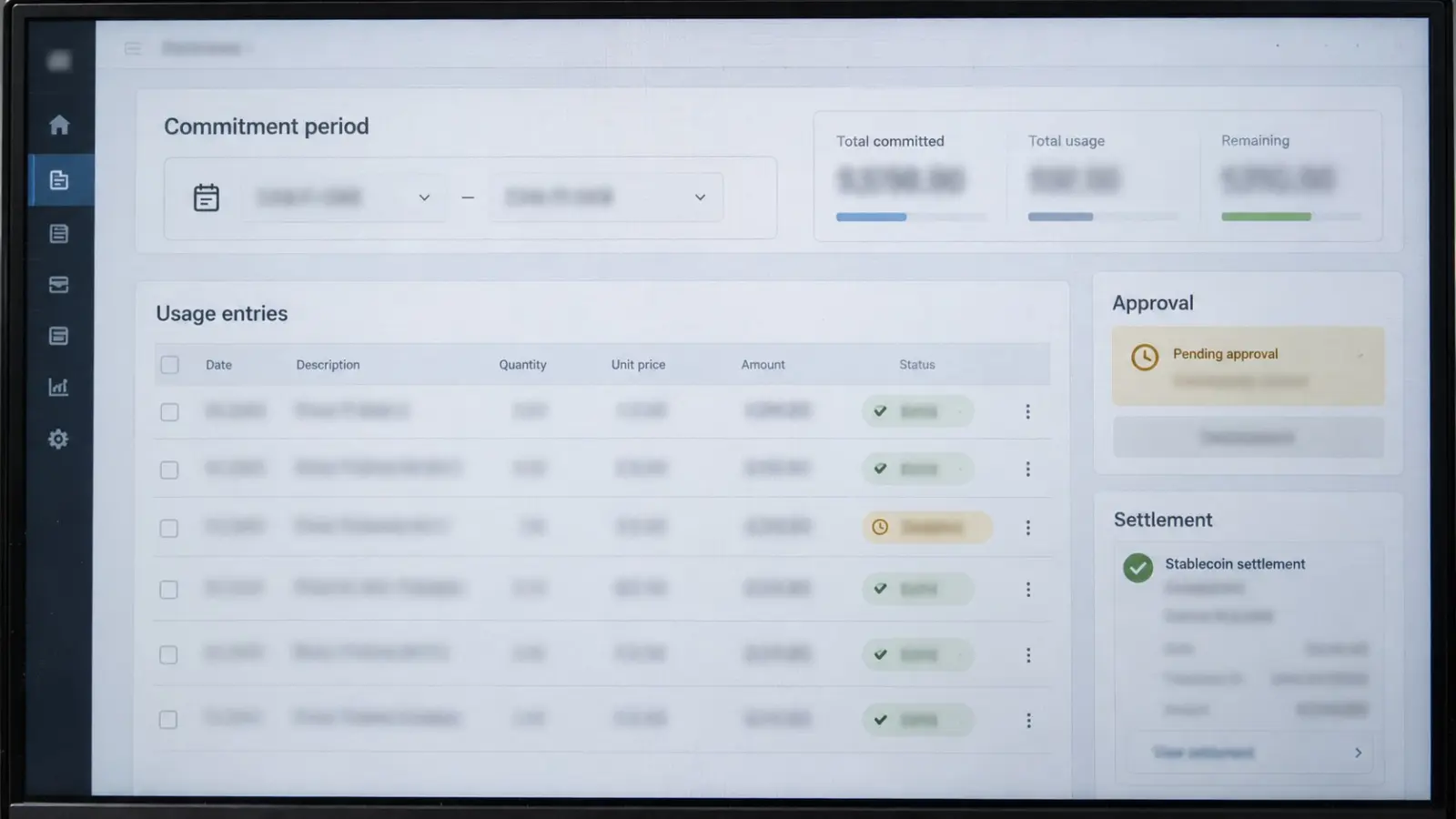
For crypto committed spend billing, treat the commitment as a contract balance rather than a stream of wallet charges. Record accepted usage in a unit ledger, convert it under the agreed price schedule, draw that value against the commitment, and invoice only the scheduled minimum or approved overage. At period close, reconcile unused value, credits, and prior collections before initiating a USDC or USDT payment. This preserves a reproducible audit trail without asking a smart contract to interpret commercial terms.
The decision behind crypto committed spend billing
Use committed-spend billing when a customer promises a minimum contract value but actual consumption varies. Do not pull funds for every usage event. Close an agreed billing period, determine the contractual amount due, then settle that amount in the chosen stablecoin.
The awkward moment is not checkout. It arrives when the usage system says the customer consumed less than the minimum, the sales order promises rollover, and the wallet approval only knows an amount and a date. Crypto committed spend billing solves that mismatch by separating three records: measured consumption, the commercial commitment ledger, and on-chain settlement. Combining them into one clever contract makes every pricing exception a software release. Cleverness is an expensive substitute for a ledger.
This model fits infrastructure, API, hosting, and B2B SaaS contracts where both parties need predictable minimum revenue and flexible consumption. It is a poor fit when every payment buys a fixed entitlement immediately, or when the customer requires open-ended postpaid credit that your risk policy cannot support. If you first need to choose the payment architecture itself, a crypto billing decision framework helps separate contract design from gateway selection.
Define the contract before designing the wallet flow
A usable commitment schedule needs explicit rules for valuation, drawdown order, overages, unused value, corrections, and approval. If any rule is merely understood, finance and engineering will eventually understand it differently.
Start with one contract currency and one price book version. State whether the commitment is billed in advance or collected periodically, which usage timestamp determines the period, and whether unused value expires or rolls forward. Define the unit precision and rounding point. If the contract is denominated in dollars but settled in USDC, say whether one USDC is treated as one dollar for invoicing or whether a quote source and timestamp determine the token quantity. That is a commercial policy, not a property of the token.
- Contract identifier, customer wallet, settlement asset and supported network.
- Period boundaries, commitment value, price-book version and accepted usage cut-off.
- Opening balance, usage value, eligible credits, drawdown, overage and closing balance.
- Invoice status, wallet collection status, transaction reference and retry history.
- Approver, reason code and immutable reference for every manual adjustment.
Use a reproducible sequence: accepted usage value equals the sum of metered units multiplied by their contracted unit prices; drawdown equals the lesser of accepted usage value and available commitment; overage equals accepted usage value minus drawdown; closing commitment equals opening commitment minus drawdown plus eligible credits. The amount collected depends on timing. Under advance funding, collect the commitment on schedule and later collect approved overage. Under periodic minimum billing, collect the greater of the period minimum and accepted usage, adjusted for credits and earlier collections.

Make routine arithmetic automatic and exceptions human-approved. A late usage file, disputed meter, backdated price change, credit, or wallet change should pause settlement until an authorized reviewer resolves it. The approval record should point to the affected ledger entries rather than overwrite them. Accounting then receives both the original event and the correction; for the downstream mapping, define a crypto billing accounting integration before the first close rather than after the first unexplained balance.
Build a commitment-to-settlement schedule
The operating artifact is a period schedule that moves left to right from contract balance to accepted usage, drawdown, overage, approval, invoice, collection, and closing adjustment. Each row should be reproducible from source records.
| Checkpoint | Contract or usage record | Calculated position | Control | Settlement action |
|---|---|---|---|---|
| Period open | $24,000 quarterly commitment; $8,000 monthly billing | $24,000 available | Confirm wallet, network, asset and price book | Collect scheduled $8,000 |
| Month one close | $6,400 accepted usage | $17,600 remaining; no overage | Approve meter cut-off | No extra collection |
| Month two close | $9,100 accepted usage | $8,500 remaining; no overage | Approve corrected usage export | Collect scheduled $8,000 |
| Month three close | $11,300 accepted usage | $2,800 overage before credit | Approve $500 service credit | Collect scheduled $8,000 plus $2,300 |
| Quarter close | $26,800 accepted usage; $500 credit | $24,000 drawn; $2,300 net overage | Match invoices and transactions | $26,300 total collected |
This is a hypothetical infrastructure vendor contract. Assume a $24,000 quarterly commitment, billed as three hypothetical monthly collections of $8,000, with no rollover and a dollar-denominated price book settled in USDC. Also assume accepted usage of $6,400, $9,100, and $11,300 by month, plus a hypothetical $500 service credit applied only against the final overage. Network fees and taxes are excluded from this illustration because their treatment depends on the merchant's policy and jurisdiction.
The usage values sum to $26,800. The commitment absorbs $24,000, leaving a $2,800 gross overage. Applying the $500 credit produces a $2,300 net overage. Scheduled collections total $24,000; the final overage collection brings gross cash collected to $26,300. Nothing is deducted twice: the credit reduces the billed overage once, while the usage ledger still preserves the original $26,800 of accepted consumption. The quarter closes with no commitment remaining and no invoice outstanding, assuming every collection succeeds.

Know where the model stops helping
A stablecoin payment rail removes neither contract ambiguity nor merchant obligations. Committed-spend billing fails operationally when metering cannot be reproduced, wallet authority is unclear, token or network terms are missing, or the merchant treats final settlement as a substitute for dispute handling.
Self-custody changes who holds funds, not who must run the business. The merchant still owns customer due diligence where applicable, sanctions controls, tax treatment, privacy, invoice requirements, and the legality of its product in each market. Stablecoin settlement can avoid card chargeback mechanics, but a mistaken charge still creates a commercial dispute and may require a refund or credit. Define that path before collecting. The practical guide to crypto billing refunds is useful because irreversible settlement makes correction design more important, not less.
A recurring wallet approval is also not an unlimited promise to pay. The customer may revoke it, change wallets, move funds, use the wrong network, or hold too little of the settlement asset when collection runs. Your receivables process therefore needs a grace policy, retry state, customer notification, and a rule for suspending service. Do not quietly widen an allowance to cover an overage the customer did not authorize; obtain an approval compatible with the contract and wallet flow.
Choose another model when metering is too disputed to close predictably, the commitment is contingent on milestones rather than consumption, settlement requires assets or networks your gateway does not support, or the customer insists on a custodian and conventional credit terms. A prepaid balance can suit hard spend caps; a fixed subscription can suit uniform access; a manual invoice can suit rare, negotiated adjustments. The distinction is contractual substance, not which interface looks tidier.

Before launch, test duplicate usage events, late events, partial periods, credit notes, failed collections, revoked approvals, wallet changes, and a disputed overage. The expected result should be both a ledger state and a customer-visible outcome. Testing only the happy-path token transfer proves the least controversial part of the system. A fuller crypto billing integration testing plan helps turn these contract cases into acceptance criteria.
Implement the close in an auditable order
Implement from contract data outward: freeze the commercial rules, normalize usage, calculate the period, approve exceptions, issue the invoice, request settlement, and reconcile the transaction. The first verifiable milestone is one closed test period that another operator can reproduce independently.
- Encode the contract fields, price-book version, period cut-off, rollover rule, credit order and settlement terms.
- Normalize usage events with stable identifiers, timestamps, quantities, contract references and deduplication rules.
- Generate a draft schedule and preserve the source-event set used for every calculated line.
- Route only exceptions for approval, then lock the approved period without deleting later corrections.
- Issue the invoice or debit notice and request only the approved stablecoin amount on the specified network.
- Record success, failure and retries separately from the usage ledger; then reconcile invoice, wallet transaction and accounting entry.
- Run a parallel test period and require a second operator to reproduce the closing commitment and amount due.
For the test close, hand a reviewer the contract snapshot, price book, accepted usage export, adjustment log, invoice, and transaction result. Ask for the opening balance, drawdown, overage, credits, collected amount, and closing balance. A mismatch must identify a source record or rule, not invite spreadsheet improvisation. Once the packet reconciles, save it as the reference case for regression testing and month-end training.

After the schedule can reliably produce an approved amount due, payment automation becomes a bounded problem. Zyrox can handle recurring USDC or USDT billing through a one-time customer wallet approval, settle funds directly to the merchant wallet, and retry unsuccessful automated billing up to five times. It does not decide whether a meter correction or credit is valid; your ledger and approval policy must do that. That is the right division of labor between commercial judgment and payment infrastructure.
Automate settlement after the ledger is sound
When your commitment schedule produces an approved amount due, Zyrox provides a non-custodial route for recurring USDC and USDT billing, with funds settling directly to your wallet. The service is free through December 31, 2026; from 2027, its fee is 0.5% of successful payments. Use the test close above to decide whether the payment layer fits your contract and controls.
Frequently asked questions
What is crypto committed spend billing?
It is a contract model in which a customer commits to a minimum value, usage draws down that value, and any approved excess is billed as overage. Crypto describes the settlement rail; the contract ledger still determines what is due.
Should the commitment be collected in advance or periodically?
Either can work. Advance collection reduces receivables exposure but requires careful treatment of unused value. Periodic minimum collection spreads cash movement but creates ongoing collection risk. Put the chosen timing, credits, and expiry rules in the contract.
How is a committed-spend true-up calculated?
Value accepted usage under the contracted price book, draw it against available commitment, then subtract eligible credits from any overage. Reconcile that amount with scheduled collections and prior adjustments before requesting the closing payment.
Can unused commitment roll into the next period?
Yes, if the contract explicitly permits rollover and defines its expiry and drawdown priority. Without that rule, the billing engine cannot infer whether unused value expires, carries forward, or becomes a service credit.
Does on-chain payment replace the usage ledger?
No. A transaction records token movement, not the source usage, price-book version, credit approval, or reason for an adjustment. Preserve the usage and commitment ledgers as the reproducible commercial record.
What happens if the customer's recurring wallet payment fails?
Keep the accepted usage intact, mark the invoice outstanding, and follow the disclosed retry, notification, grace, and service-suspension policy. A payment failure changes receivables status; it should not rewrite consumption.
Which stablecoin and network should the contract specify?
Specify one supported settlement asset and network for each payment instruction, plus the policy for network fees, wallet changes, and denomination. Confirm that both parties and the selected gateway support that exact combination.
What should be tested before going live?
Test duplicate and late usage, partial periods, credits, disputed overages, revoked wallet approvals, insufficient balances, retries, and reconciliation. A second operator should reproduce the amount due from the retained source packet.

Alexa Buzoverova
Project lead at Scrile. Helps clients pick what actually moves growth and bridges them with the engineering team. Writes about the operational side of software delivery — scoping, requirement translation, and vendor-team alignment.
Reviewed under our Editorial standards.