Quick answer
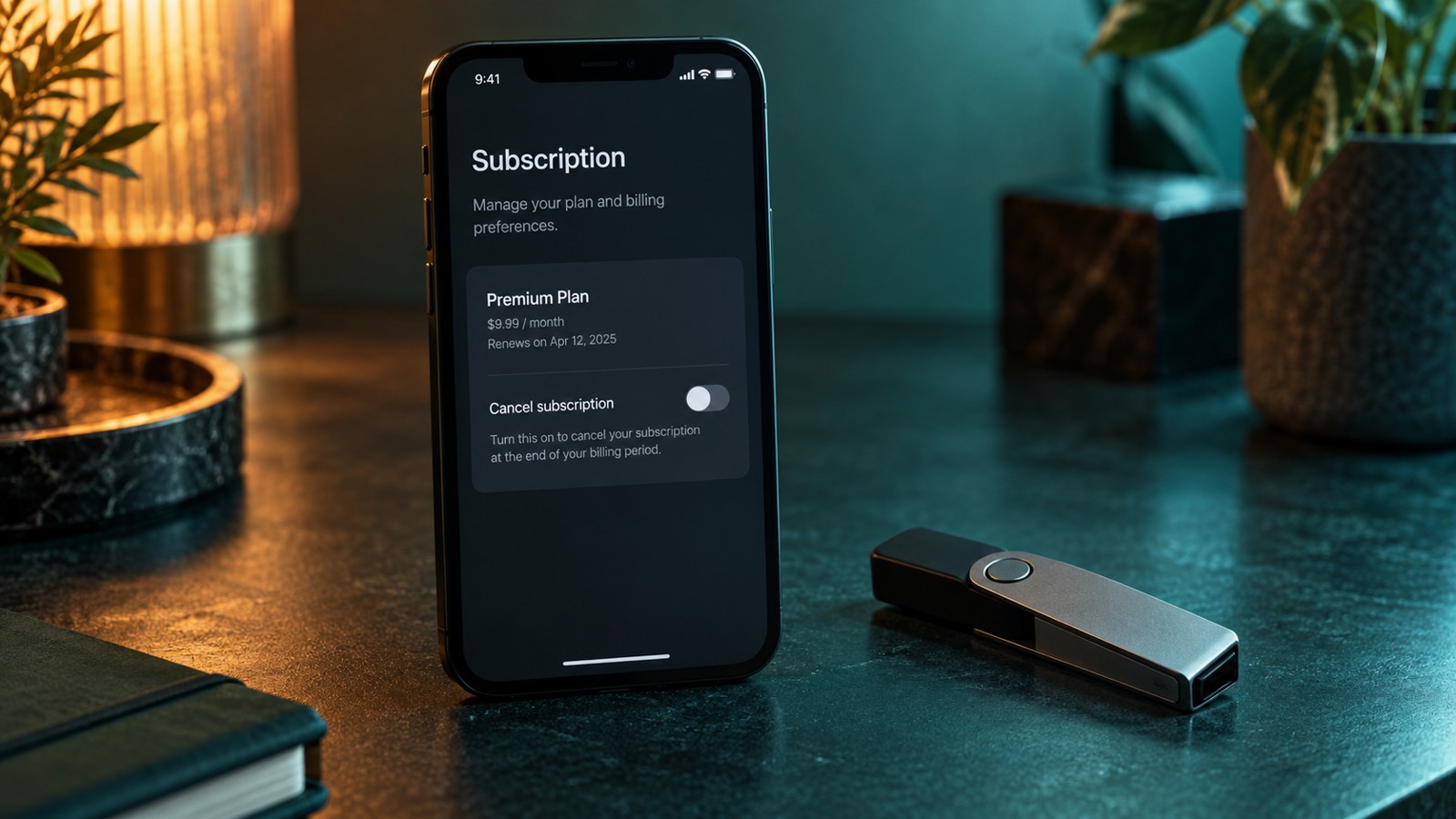
To cancel crypto subscription billing safely, the customer should cancel renewal in the merchant’s account portal and receive a clear effective date, access end date, invoice status, and confirmation. If a token allowance remains active, the customer may also need to revoke that permission in the wallet or through the relevant network explorer. Disconnecting a wallet alone does not revoke a smart contract’s authority to spend approved tokens.
What must happen when a customer chooses to cancel crypto subscription billing?
Cancellation should stop future renewal authority on a stated date without silently rewriting access, invoices, or settled payments. Give the customer one self-service action, then report each resulting state separately.
A card portal encourages a convenient fiction: click cancel and the payment method, mandate, invoice schedule, and product access all move together. On-chain billing is less forgiving and therefore more honest. The merchant database controls entitlement and renewal scheduling; a token contract controls an allowance or collection permission; the wallet controls signatures. A reliable flow coordinates those systems but never implies that an off-chain account change has already altered an on-chain permission.
- Show whether cancellation is immediate or effective at the end of the paid term.
- Stop creation or collection of future renewal charges at the effective time.
- Preserve access already purchased unless the stated refund policy says otherwise.
- Display open, paid, failed, and voided invoices as distinct outcomes.
- Offer an on-chain revocation path when collection authority can remain after cancellation.
- Issue a durable confirmation containing the subscription, wallet, network, and effective status.
The practical test is simple: after acting, can the customer answer “Can another charge occur?” without opening a support ticket? If not, cancellation is unfinished. Teams planning the wider payment lifecycle should place this policy inside their crypto billing platform architecture, because contract authority and application entitlement fail in different ways. The next action is to define the effective-cancellation rule before designing the button.

Which states and actions belong in the self-service cancellation model?
Model cancellation as transitions among active, cancel-scheduled, expired, payment-failed, and suspended states. Then assign explicit rules for collection, access, invoices, wallet authority, and reactivation.
| State | Future collection | Customer access | Customer action | Support review |
|---|---|---|---|---|
| Active | Allowed under current authority | Available | Cancel, replace wallet, or remove authority | Only for disputes or risk flags |
| Cancel scheduled | Blocked after effective date | Available through paid term | Reverse cancellation or revoke allowance | If an open invoice is disputed |
| Expired | Blocked | Ended | Reactivate with current or new wallet | If historical records conflict |
| Payment failed | Retry only under disclosed policy | Grace rule applies | Fund wallet, replace wallet, or cancel | If repeated failures need review |
| Suspended | Policy-dependent; disclose clearly | Restricted | View status and contact support | Required before reactivation |
Wallet replacement is not a cosmetic profile edit. The old wallet may retain an allowance while the new wallet lacks one. Use a two-part transition: authorize the replacement wallet, then show whether the old wallet’s authority has been revoked. Removing a payment method should similarly stop scheduled collection, but it need not erase invoice history or settle an existing debt. For broader vendor evaluation, apply the same separation in a crypto billing decision framework.
Self-service should handle normal, reversible transitions. Support should review ownership disputes, conflicting on-chain and application records, refunds after settlement, suspected compromise, and policy suspensions. This boundary lets customers control ordinary renewal decisions without giving a convenient button the power to rewrite accounting history. Implement the table as executable transition rules, not merely help-centre prose.

Does cancelling the account also revoke the wallet permission?
Not necessarily. Cancelling in the merchant application can stop its scheduler, but disconnecting a wallet does not itself remove an existing token allowance. Customers need a separate, verifiable revocation route when authority persists on-chain.
Treat application cancellation and contract revocation as two controls protecting against different failures. The application control tells the merchant not to initiate another renewal. Revocation changes what the approved contract can do with the token on the selected network. A customer must use the same wallet and correct network, submit the revocation transaction, pay the applicable network fee, and wait for confirmation. The account should then distinguish “renewal cancelled” from “allowance revoked.”
Pending invoices require equally precise language. A cancellation may prevent the next invoice from being generated while leaving an earlier invoice open. It may also occur after a payment has settled, in which case reversing access is not a refund. Define whether open invoices remain collectible, become void, or require review; then keep the ledger outcome aligned through a crypto invoice correction process rather than deleting inconvenient records.
- Confirm the wallet address, token, contract, and network associated with the subscription.
- Stop future merchant-initiated collection according to the published effective date.
- Offer a direct revocation instruction and warn that wallet disconnection is insufficient.
- Verify the confirmed on-chain result before displaying authority as removed.
- Retain invoice and access history even after the payment permission is gone.
How should cancellation work in a real subscription journey?
The cleanest journey preserves the purchased term, blocks the next collection, exposes remaining wallet authority, and makes reactivation a fresh affirmative choice rather than a hidden reversal.
Consider this hypothetical assumption: an AI API plan costs $49 per month, renews on June 12, and the customer schedules cancellation on June 7. Assume the June term is already paid, there is no open invoice, and the merchant promises access through the paid term. The portal records cancel-scheduled immediately, prevents the June 12 collection, preserves API access until June 12, and shows whether the USDC allowance still needs revocation. At Zyrox’s 0.5% platform fee, a completed hypothetical $49 collection would carry a $0.245 platform fee; because the scheduled renewal is blocked before collection, that renewal creates no completed-payment fee.
If the customer changes their mind before expiry, reactivation can remove the scheduled cancellation while the existing wallet authority remains valid. If they return after expiry or previously revoked the allowance, reactivation should require a new approval rather than interpreting an old wallet connection as consent. The product team should test these branches with the same seriousness as checkout; the crypto billing integration testing plan must cover delayed confirmations, duplicate events, failed revocations, and stale wallet records.
The accounting record should show no renewal payment, no refund, and uninterrupted service only through the existing entitlement. That is the virtue of state separation: finance, support, and the customer all see the same story. Write an acceptance test for each event and expected state before implementation begins.

Now change one assumption: the renewal transaction was submitted before cancellation and confirms afterward. The cancellation request should still block later renewals, but the submitted transaction needs a defined resolution path. Depending on the disclosed policy and service delivery, the merchant may preserve the new term, issue a discretionary refund, or escalate the case. The portal must not silently call the payment “cancelled,” because confirmed settlement and subscription cancellation are different facts. Store the request time, submission time, confirmation time, and entitlement decision so support can explain the outcome.
How do you implement cancellation without creating support debt?
Implement the state rules before the interface: define authority, transitions, event ordering, customer messages, and reconciliation ownership; then connect the button to those rules and test every terminal outcome.
- Define renewal, entitlement, invoice, wallet, and contract-authority states independently.
- Choose effective dates for voluntary cancellation, failed payment, suspension, and reactivation.
- Specify which transitions customers can perform and which require support review.
- Make wallet replacement and payment-method removal explicit multi-system workflows.
- Process contract and payment events idempotently, retaining timestamps and identifiers.
- Test cancellation before, during, and after renewal submission on every supported network.
- Publish confirmation language that states future collection, access, invoice, and revocation status.
- Reconcile merchant records, on-chain results, and accounting exports after launch.
The design does not remove the merchant’s compliance burden. Consumer cancellation rules, tax records, sanctions controls, refund obligations, and data-retention requirements vary by jurisdiction and business model. Obtain appropriate advice and encode the resulting policy rather than asking a smart contract to improvise law. Operationally, connect confirmed state changes to your crypto billing webhook integration and monitor disagreements between chain events and account records.
A build may be justified when contract behaviour is central intellectual property and the team can own audits, monitoring, support tooling, and upgrades. Otherwise, compare the full operational burden through a build vs buy crypto payment gateway assessment. The verifiable launch criterion is not that the cancel button works; it is that a test customer can cancel, inspect authority, retain the correct access, and reactivate without contradictory states.

Make cancellation as credible as checkout
Recurring crypto billing earns trust when customers can see exactly when collection authority ends, how long access remains, what happens to invoices, and whether their wallet still grants permission. That clarity also gives support and finance one defensible operating record.
Zyrox supports smart-contract subscriptions, direct settlement to the merchant wallet, payment links, webhooks, and integrations for subscription businesses. Customers approve recurring USDC billing through their wallet, funds settle without a third-party custodian holding the merchant balance, and the platform fee is 0.5%. Review the wider solution before deciding how to implement cancellation and renewal control.
Frequently asked questions
How do I cancel a crypto subscription?
Cancel renewal in the merchant’s account portal, note the effective and access-end dates, then check whether you must separately revoke the token allowance on the correct network.
Does disconnecting my wallet cancel a crypto subscription?
No. Disconnecting removes the site connection but may leave token spending authority active. Cancel with the merchant and verify or revoke any remaining allowance separately.
Will cancelling immediately remove my access?
That depends on the merchant’s published policy. A well-designed flow states whether access ends immediately or continues through the already-paid term before confirmation.
Can a merchant charge me after I cancel?
Future merchant-initiated renewals should stop according to the effective date, but a transaction already submitted or an unresolved invoice may need separate handling. Check both the account state and on-chain authority.
How do I remove a wallet from a subscription?
Use the merchant’s wallet-replacement or payment-method-removal flow, then verify whether the old wallet’s allowance was revoked. Removing an address from a profile alone may be insufficient.
Can I reactivate a cancelled crypto subscription?
Usually, if the merchant supports reactivation. An unexpired subscription may reuse valid authority; an expired subscription or revoked allowance should require a fresh approval.
Does cancellation refund a settled crypto payment?
No. Cancellation stops or schedules the end of renewal. A settled payment requires a separate refund decision and reconciliation record under the merchant’s policy.
Who pays the network fee for revoking token access?
The wallet submitting the revocation transaction normally pays the applicable network fee. The amount depends on the selected network and conditions when the transaction is submitted.

Tatyana Ershova
Account management at Scrile. Writes about B2B sales cycles, vendor-client communication, and the unglamorous middle of enterprise deals.
Reviewed under our Editorial standards.