
USDC is no longer the odd extra button on a checkout page. For many online businesses, it is the practical stablecoin choice: dollar-denominated, widely supported, and cheap to move on the right networks. It also avoids a lot of the damage card rails bring with them, including chargebacks, rolling reserves, and processor freezes.
Yet deciding to accept USDC is the easy part. Choosing a setup that does not create new problems is harder. Wrong-network transfers, custody lock-in, ugly reconciliation, payout delays, and support chaos show up fast when the payment flow is held together by copied addresses and wishful thinking.
If you want to accept USDC payments without the usual crypto headaches, this guide is for that exact moment. We will keep the theory short, compare the four real ways to do it, show where each one breaks, and walk toward the cleanest implementation path for a merchant or platform team.

Quick answer: the cleanest ways to accept USDC payments in 2026
There are four real ways to accept USDC as payment. The right one depends on how much control you need, how often you expect payments, and whether your team can handle the operational work.
- Raw wallet address: fastest to start, weakest for checkout, tracking, and support.
- Custodial crypto gateway: easier for hosted checkout and reporting, but a third party controls the flow.
- Self-hosted tools: strong ownership, higher setup and maintenance burden.
- Non-custodial gateway flow: the best fit for many teams that want direct settlement without building every piece from scratch.
If you send a few one-off invoices each month, a wallet address may be enough for now. However, once payments become repeatable, customer-facing, or support-heavy, that rough setup starts leaking time. Meanwhile, if your business cannot tolerate frozen funds or payout surprises, custodial convenience gets expensive the moment something goes wrong.
That is the real fork in the road. Most teams do not struggle because USDC is confusing. They struggle because they choose an acceptance model that does not match how the business actually runs.
What USDC is in 60 seconds, and why merchants use it instead of BTC or ETH
USDC is a dollar stablecoin issued by Circle. In plain language, it is designed to track one US dollar, and Circle publishes reserve attestations tied to the assets backing it on its Official USDC documentation. For a merchant, the useful part is simple: USDC behaves like a payment asset, not a bet on price swings.
That matters because online businesses price things in dollars. If you charge $49 for a subscription, a hosting plan, or an API package, you usually want to receive something that still acts like $49 when finance closes the books. BTC and ETH can work for some buyers, but they bring volatility into a place where most merchants want predictability. Anything else will not hold.
USDC also exists on multiple blockchains. Because of that, “accept USDC payments” is never one single setup. Accepting USDC on Ethereum differs from accepting it on Solana, Polygon, Arbitrum, Base, Optimism, or BNB Chain. Fees change. Wallet support changes. Customer error rates change too.
Fees are a good example. On Ethereum mainnet, transaction costs can still climb during busy periods. On lower-cost networks such as major L2s, sending USDC is often much cheaper, and Solana transfers are typically very low-cost as well. Therefore, chain choice is not a side detail. It shapes checkout friction, failed payments, and support load from day one.

Why merchants accept USDC at all: the business case that matters
Most merchants do not start looking at USDC because they suddenly became crypto believers. They start because card rails are expensive, brittle, or hostile to their category.
A familiar pattern looks like this: fees around 2.9% plus fixed charges, delayed payouts, reserve requirements, cross-border declines, and a constant low-grade fear that underwriting will tighten just as revenue starts to matter. For some industries, the problem gets worse. Legal businesses still get treated like a risk memo.
USDC changes that equation in a few practical ways. First, the value is stable relative to USD, so pricing is easier. Next, on-chain transfers do not follow the normal card chargeback path because blockchain transactions are generally irreversible once confirmed, as explained in the Blockchain overview. Also, settlement can happen in minutes rather than on a processor timetable. On lower-fee chains, network costs are often small enough to make low-ticket digital sales workable. Finally, customers who cannot or do not want to use cards still have a route to pay.
There is a real cost to getting this wrong. Every failed payment attempt is a customer who was ready to buy and did not. Every reserve hold is cash flow you already earned but cannot use. Every dispute is time burned after the sale. That drain adds up quietly, then all at once.
When USDC acceptance is set up well, the upside is bigger than fee savings. It can unlock international demand, reduce failed card attempts, support digital businesses in the $5 to $500 range, and give the business a payment rail it actually controls. Built properly, it becomes infrastructure, not a patch.
The four ways to accept USDC, and where each one breaks
1. Raw wallet address copy-paste
This is the first setup many merchants try. Put a wallet address on an invoice, a checkout note, an email, or a support chat. Ask the customer to send USDC. Check the transaction yourself. Mark the invoice paid.
For low volume, it can work. For a while.
Then the cracks show. Customers ask which network to use. One sends bridged USDC when you only support native USDC. Another uses the wrong chain entirely. Someone else sends the right amount but includes no reference, so support and finance end up matching payment screenshots against block explorers by hand.
Here is where almost everyone loses. They confuse “technically possible” with “operationally usable.”
Imagine a small API business billing trial upgrades by invoice. In the first month, ten customers pay to a pasted wallet address. Fine. By month three, forty customers pay across Ethereum, Polygon, and Arbitrum. Two deposits come in short because of exchange withdrawal behavior. Three have no customer reference. One lands on a network nobody is watching. The issue is no longer crypto. The issue is that there is no payment system.
Use this path only when payment volume is low, payments are mostly one-off, and your team can live with manual reconciliation. Otherwise, the cheap setup becomes expensive in staff time.
2. Custodial crypto payment gateway
A custodial gateway usually fixes the obvious rough edges. You get hosted checkout, payment links, status tracking, webhooks, and cleaner reporting. As a result, the customer experience tends to improve fast, especially for one-time payments.
However, the trade-off is control.
In a custodial model, a processor often receives or manages the funds flow before you do. That usually means KYC or KYB checks, account reviews, supported-chain limits, payout rules, and the possibility of restrictions later. For a mainstream merchant that wants a managed setup and maybe fiat settlement, that can still be acceptable. For a business already living with payment discrimination, it can feel like recreating the same dependency in a different wrapper.
Launch convenience is real. So is frozen-funds risk.
This path makes sense when you want a familiar managed flow and can tolerate processor oversight. It is a weaker fit when direct access to revenue matters more than managed comfort.
3. Self-hosted tools such as BTCPay or Bitcart
Self-hosted tools attract teams that want more ownership. You run the stack yourself, connect your own wallets or infrastructure, and avoid giving custody to a third party. That is the upside.
The other side is work. You need deployment, monitoring, upgrades, wallet management, webhook handling, reconciliation logic, and someone on the team who will still care about this system six months after launch. Otherwise, the payment stack turns into an abandoned side project with production consequences.
For a capable technical team, self-hosting can be a solid answer. In contrast, for an ops-heavy business with limited engineering bandwidth, it often creates a hidden tax that never really stops. Control is valuable, but unsupported control is brittle.
4. Non-custodial gateway flow
This is often the cleanest path for digital businesses that want a proper checkout flow without handing custody to a processor. In a non-custodial setup, the payment experience feels more like a gateway, but settlement goes directly to the merchant wallet instead of passing through a custodian account first.
In the Zyrox model described here, customers approve via wallet and smart-contract-based billing logic can pull USDC according to the configured payment flow. Funds settle directly to the merchant wallet, and the stated platform fee is 0.5%.
That changes the shape of the risk. You still handle merchant-side compliance, wallet security, sanctions controls, and accounting. But you remove one of the ugliest points of failure: a third party sitting between your customer payment and your access to funds.
Consider a hosting reseller serving buyers in LATAM and Southeast Asia. Card approval is inconsistent, and disputes are expensive. A custodial processor looks easy at first, yet payout reviews and category risk could still interrupt operations later. A non-custodial flow gives that team a cleaner answer: wallet-based payment, direct receipt to the business wallet, and an admin layer built around their own process.
Custodial gateway vs non-custodial setup: fees, speed, and frozen-funds risk
The useful comparison is not “which one gets me live fastest?” The better question is “which one still works when payment volume grows, support gets noisy, and finance wants reliable control?”
| Factor | Custodial gateway | Non-custodial setup |
|---|---|---|
| Who controls funds first | Processor or custodian | Merchant wallet |
| Typical onboarding friction | Often higher because of KYC/KYB and policy review | Lower on the custody side, although the merchant still carries compliance duties |
| Payout timing | Depends on processor schedule and rules | Direct on-chain settlement |
| Frozen-funds risk | Meaningful if the account is flagged or restricted | Lower custody risk, but wallet security becomes critical |
| Chain flexibility | Limited to the networks the processor supports | Often broader, depending on implementation |
| Refund handling | Usually more guided, but processor-dependent | More direct, though the merchant must design the workflow |
| Fees | Processor fee plus possible conversion or spread costs | Platform fee plus network costs; Zyrox states a 0.5% platform fee |
| Best fit | Merchants who want a managed setup and accept custody trade-offs | Merchants who want control and direct settlement |
There is no universal winner. Still, there is a clear bad fit. If your business already suffers from reserves, account holds, or payout friction, moving into another custody-first model may reproduce the same problem with better branding and the same weakness underneath.
That is the part many competitor pages glide past. They explain how to turn the feature on. They spend far less time on what happens after you depend on it.
Which USDC acceptance model fits your business type?
Start with three questions. Do you need direct access to funds, or are managed payouts acceptable? Are payments one-off, invoice-based, or recurring? And can your team handle wallet security and reconciliation without outside hand-holding?
Those answers narrow the field quickly.
SaaS, AI tools, and API services: these teams usually care about low fees, global access, and recurring billing potential. Raw wallet acceptance is usually too manual unless volume is tiny. A non-custodial gateway path is often the better long-term fit if direct settlement matters.
Ecommerce: if you need a straightforward one-time checkout inside an existing store setup, a gateway may be enough. On the other hand, if your products, geography, or category make processor dependence risky, think much harder about custody before you commit.
Marketplaces and platforms: a pasted wallet address is almost never enough. You need status tracking, internal admin views, accounting logic, and role-based visibility. At that point, accepting USDC becomes an operations product, not a payment button.
Creator, fan, adult, and grey-area businesses: these businesses often feel the pain first because traditional processors hesitate, freeze, or refuse sooner. In that context, control is not a nice upgrade. It protects margin and continuity.
Hosting and WHMCS resellers: recurring invoices, global buyers, and fraud-sensitive card flows make USDC attractive. Because of that, it pays to design for structured payment operations from the start rather than patching them in later.
NFT and Web3 services: your users may already be wallet-comfortable, which lowers checkout education costs. Even then, chain choice and clean reconciliation still matter.
If your business needs repeatable online payments, support sanity, and month-end visibility, copy-paste wallet acceptance is a dead end. Start cleaner.
Which chain should you support first for USDC?
Most teams treat this as a technical choice. It is really a checkout and support choice.
Ethereum has the strongest recognition and broad wallet support, but fees can be much higher. Solana is fast and cheap, although not every customer base is equally comfortable there. Polygon, Arbitrum, Base, and Optimism offer lower-cost EVM paths that often make sense for online businesses. BNB Chain can matter too, especially if your users already hold funds there, but that should come from customer demand rather than habit.
Choose the first chain based on where your customers already hold USDC, whether their wallets support the flow cleanly, how much the network fee matters at your average order value, and how much wrong-network support load your team can absorb. If you expect to add USDT or multi-chain checkout soon, that should shape the decision early as well.
For example, if your average payment is $15, Ethereum mainnet may be a poor fit when a lower-cost chain can do the same job with less friction. Meanwhile, if your buyers are institutional or already transact heavily on Ethereum, the fee trade-off may be worth it. Context decides.
| Chain | Merchant fit | Cost profile | Main caution |
|---|---|---|---|
| Ethereum | Strong recognition and broad wallet support | Higher fees | Can be a poor fit for low-ticket payments during congestion |
| Solana | Fast and cheap for wallet-native users | Very low fees | Not every audience uses Solana wallets |
| Polygon | Good low-cost EVM option | Low fees | Needs clear network instructions |
| Arbitrum | Strong L2 choice for EVM users | Low fees | Customer familiarity varies |
| Base | Good for Coinbase-adjacent and EVM users | Low fees | Support depends on customer wallet habits |
| Optimism | Useful low-cost EVM route | Low fees | Less universal than Ethereum itself |
| BNB Chain | Relevant for some global user bases | Low fees | Should match real customer demand |
If you already know one network will not be enough, read Accept USDC + USDT on Multiple Blockchains (2026 Multi-Chain Guide). That is the next step once single-chain clarity turns into real checkout design.
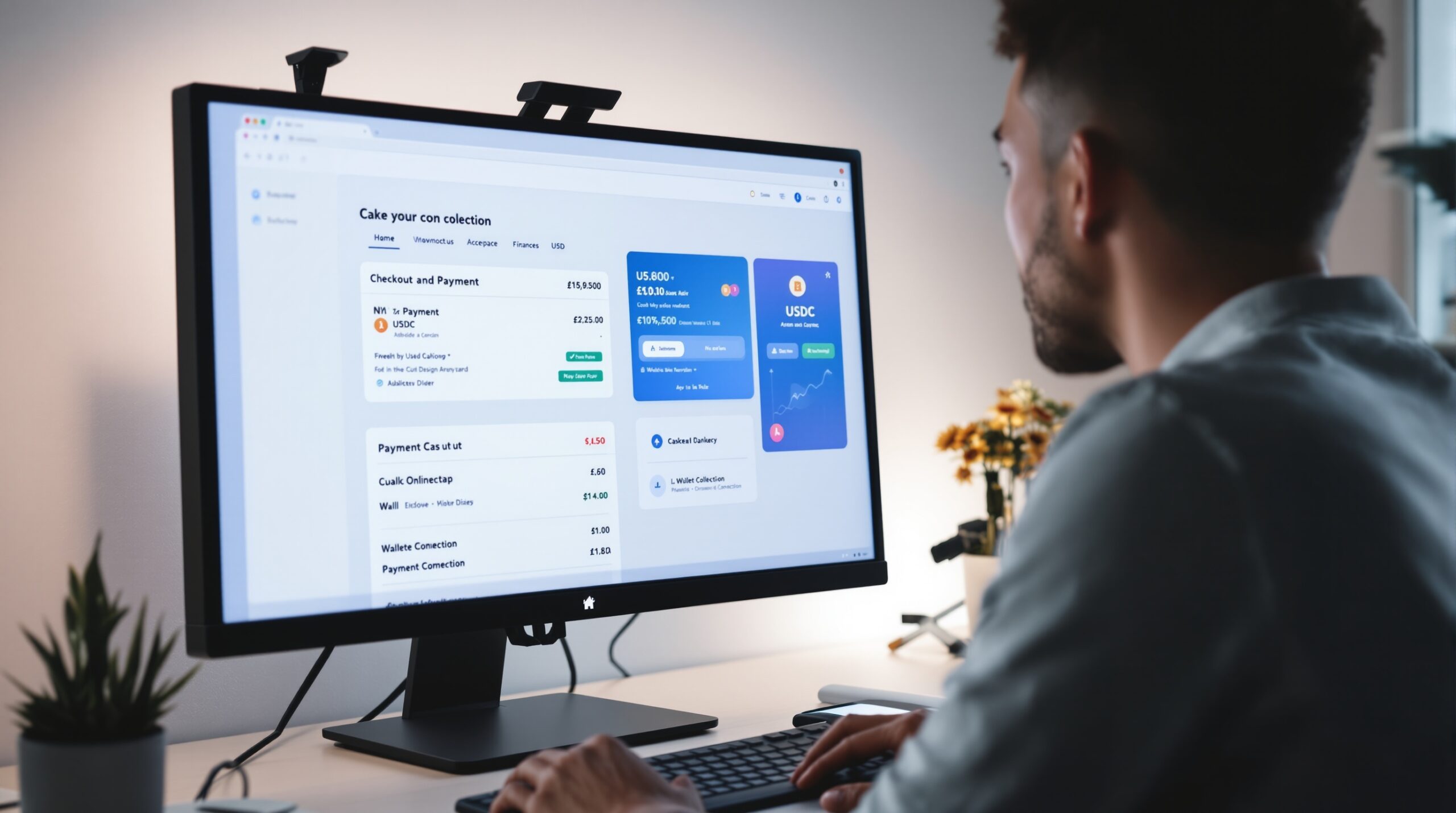
A practical 5-step setup with Zyrox
Once direct settlement starts to matter more than custody convenience, implementation becomes the real question. A structured non-custodial flow helps because it gives you checkout logic without forcing your revenue through a processor balance first.
- Connect your merchant wallet. decide up front which wallet receives funds, who controls keys, and who in finance or ops needs visibility without signing rights.
- Create a payment link or use an API integration. payment links work for simple use cases. API integration is better when you need embedded checkout, internal logic, or platform workflows.
- Embed the payment flow in checkout. name the chain clearly. “USDC on Arbitrum” is far safer than a vague “Pay with USDC” label.
- Receive USDC directly. in the non-custodial model described here, settlement goes to the merchant wallet instead of stopping in a processor account first.
- Withdraw, convert, or reconcile based on policy. some businesses hold USDC for expenses or treasury. Others off-ramp part of it. Decide the rule before launch.
A real payment operation does not end at “payment received.” It needs internal visibility, clear statuses, support clues, wallet governance, and accounting outputs that finance can trust at month-end. Otherwise, the checkout works while the business around it does not.
That is also the point where generic advice runs out. If your team is moving from evaluation to implementation and needs the admin layer around USDC operations, Zyrox is a practical foundation to evaluate. It is a React dashboard template built with Material UI, aimed at teams that need a ready-made interface for admin panels, reporting, internal workflows, and merchant views.
Used well, it shortens the hardest stretch: the gap between “we want to accept USDC” and “we have a working operations layer people can actually use.” It is not the payment rail itself. Instead, it is the build surface around the payment decision, where status tracking, reconciliation, and control start to matter.
A mini-story from a team that needed control, not just another gateway
A small subscription business started with the usual goals: lower payment costs, fewer disputes, and better access for customers outside its strongest card markets. Their first USDC flow was improvised. Wallet instructions went out manually. Payments were tracked in spreadsheets. Support checked block explorers whenever a customer said they had already paid.
It worked until volume arrived.
Then the process turned into a maze. Finance no longer trusted the records. Support could not quickly tell the difference between wrong-network payments and slow confirmations. Product wanted a proper checkout, but the team did not want to swap card dependence for processor dependence.
The fix was not “more crypto.” It was better operations: one defined chain to start, direct settlement to the business wallet, a proper customer payment flow, and an internal admin layer where non-engineers could finally see what had happened. Payments rarely break at the wallet itself. They break in the handoff between customer action and business visibility.
Compliance reality check before you launch
Accepting USDC does not erase compliance work. It changes the shape of it.
You may still need KYB or KYC processes depending on your jurisdiction, customer base, and business model. You should also think about sanctions screening, wallet monitoring where appropriate, tax reporting, refund policy design, and bookkeeping rules for digital asset receipts. Businesses with US touchpoints should at least understand the US Treasury OFAC sanctions framework before launch, because sanctions obligations do not disappear just because payment arrives on-chain.
Set policy before launch, not after the first messy payment. Which regions will you accept? Who reviews suspicious transactions? How are refunds approved and recorded? How are wallet keys secured? When do you hold USDC, and when do you convert it? Those choices should not be improvised in a support thread.
No honest guide should pretend this is set-and-forget. However, there is a big difference between carrying responsibility and living at the mercy of a processor. Running your own controls takes work. Waiting for someone else to decide whether you can access your own revenue is worse.
Common pitfalls that cause USDC payment failures
Most USDC payment failures are preventable. Usually, they come from vague instructions, sloppy chain support, or unfinished internal process.
Bridged vs native USDC: do not assume every USDC-looking asset is acceptable for your flow. Be specific about what you support and where.
Wrong-network deposits: this is the classic failure. A customer sends USDC on one chain while your team is watching another. Therefore, the checkout should name the chain clearly, and support should have a written procedure for what happens next.
Decimals confusion: custom integrations can display or store token amounts incorrectly. USDC typically uses six decimal places on supported networks, so one bad assumption in code can corrupt downstream reconciliation.
Wallet compatibility assumptions: just because USDC exists on a chain does not mean your customers’ wallets and exchanges make that chain easy to use. Test the actual user path.
Manual reconciliation drift: once staff start matching payments by memory, screenshot, or timestamp guesswork, accuracy is already slipping.
This kind of failure rarely looks dramatic on day one. It looks like one missing payment, one confused support ticket, one refund handled ad hoc, one spreadsheet note nobody fully trusts. Then it compounds, like sand in gears.
Trade-off: simplicity now vs control later
If you want the shortest path to “we accept USDC,” use a wallet address or a managed gateway. If you want a setup that survives growth, decide based on who controls funds, how refunds work, which chain your customers really use, and whether finance can reconcile without heroics.
Simple setups lower launch friction. Later, they often raise support friction.
More controlled setups ask for clearer decisions up front. In return, they usually reduce payout dependence, finance mess, and support drag once volume grows.
For a hobby project, you can dodge this decision. For a real business, you cannot. The price of staying vague gets paid in delayed cash flow, support labor, and internal distrust of your numbers.
What to do next if you want a cleaner implementation path
If you came here asking how to accept USDC payments, the answer should now feel narrower and more useful. You are not choosing a coin. You are choosing a payment operating model.
Start with one chain your customers already use. Define refund handling and reconciliation before launch. Decide whether direct settlement matters enough to avoid custodial dependence. Then test the whole flow with small live payments, including the ugly cases: wrong amount, wrong chain, slow confirmation, refund request. That is where weak setups get exposed.
If you are already past the “just post a wallet address” stage and need the build layer around USDC operations, try Zyrox. For teams building admin panels and merchant-facing dashboards, it gives you a React and Material UI base for payment views, internal controls, reporting, status screens, reconciliation, and user roles. That is often the missing layer between accepting USDC in theory and running it cleanly in production.
And if the next question on your desk is larger than USDC alone, go straight to the multi-chain USDC + USDT guide. That is the next sensible move when one-chain acceptance is no longer enough and you want a setup that can grow into a real asset for the business.
Frequently asked questions
Is USDC the same as USD?
No. USDC is a dollar-pegged stablecoin, which means it is designed to track the value of one U.S. Dollar, but it is still a crypto asset. For merchants, that makes it useful for pricing and settlement, while keeping the payment flow on-chain. The important distinction is that it is not a bank deposit or cash in a bank account.
What chains support USDC?
USDC is available on multiple blockchains, including Ethereum, Solana, Polygon, Arbitrum, Base, Optimism, and BNB Chain. The exact networks you should support depend on your audience, fee sensitivity, and how much operational complexity you can handle. Supporting the wrong chain mix can create failed payments and support issues, so chain choice should be part of the checkout design.
Do I need KYC to accept USDC?
Not always, but it depends on the setup you choose. A raw wallet address or a non-custodial flow can usually avoid processor-level KYC because you are receiving funds directly, while custodial gateways often require KYC or KYB. If keeping direct control of funds matters, that difference is one of the main reasons merchants avoid custodial providers.
What are typical fees on USDC transfers?
Fees depend heavily on the blockchain. Ethereum mainnet can become expensive during busy periods, while networks like Solana and several L2s are usually much cheaper. For merchants, the real cost is not only the on-chain fee but also the operational cost of handling wrong-network payments, reconciliation, and support.
How do I withdraw USDC to my bank?
USDC does not move to a bank account directly, so you usually need to convert it to fiat through an exchange, a payment provider, or a payout service that supports bank transfers. With a custodial gateway, fiat payout may be built in, while a direct or non-custodial setup usually requires your own off-ramp process. If bank settlement is a priority, confirm the payout path before you launch.
Which USDC acceptance model is best for a growing business?
For many digital businesses, a non-custodial gateway flow is the most balanced option because it gives you a proper checkout experience without handing custody to a processor. Raw wallet addresses are fine for low-volume invoices, but they become hard to manage once payments repeat or support gets involved. The best choice depends on how much control, automation, and operational simplicity you need.
Accept USDC + USDT on Multiple Blockchains (2026 Multi-Chain Guide)

Dmitry Rusanov
Product designer at Scrile. Focused on user value and business outcomes. Writes about interface decisions, design-system economics, and where UX investment actually pays back.
Reviewed under our Editorial standards.